The Thomas Hardy archive held at Dorset History Centre is the largest collection of Thomas Hardy’s papers internationally. The archive was catalogued between March 2024 and October 2025 with funding from The National Archives, Dorset Archives Trust, The National Trust, The Valentine Trust, The Cooper-Dean Charitable Foundation and a large number of donations from members of the public. The catalogue is available to view online as part of Dorset History Centre’s wider archive catalogue.
Thomas Hardy
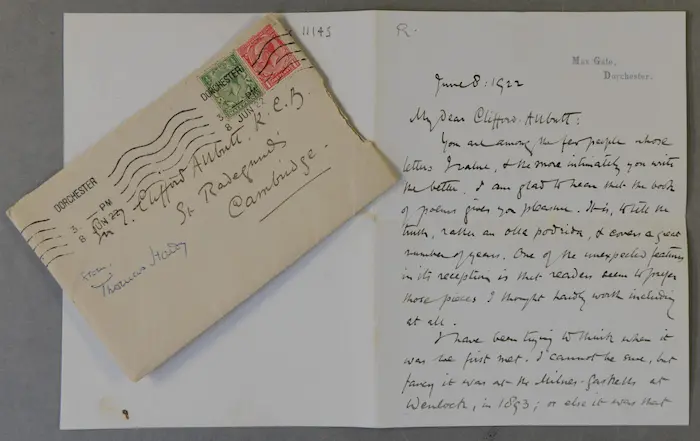
Thomas Hardy was a novelist and poet who was born in 1840 at Higher Bockhampton and died at home at Max Gate, Dorchester, in 1928. Fourteen of Hardy’s novels were published during his lifetime, including Far From the Madding Crowd, Tess of the d’Urbervilles and Jude the Obscure, and he wrote almost a thousand poems. Hardy’s work was acclaimed by both Victorian and modern writers and poets. Many of their letters can be found in the archive and attest to Hardy’s reputation and his influence. Correspondents include J.M. Barrie, Millicent Garrett Fawcett, Rudyard Kipling, Eliza Lynn Lynton, Siegfried Sassoon, Robert Louis Stevenson, Marie Stopes, Virginia Woolf, and W.B. Yeats.
The Thomas Hardy archive
The Thomas Hardy archive has been accrued for over a century. The majority of the archive is owned by Dorset Museum and Art Gallery and is held on deposit at Dorset History Centre. Other items include material deposited, gifted or purchased by Dorset History Centre, which continues to acquire archive material related to Thomas Hardy when funding is available. Thomas Hardy donated his manuscript of The Mayor of Casterbridge to Dorset County Museum in 1911, and a significant number of items in the archive were bequeathed directly to the Museum by Thomas Hardy or members of his family. Other items were acquired from contemporaries of Hardy including H.O. Lock and significant collectors including Frederick B. Adams, and E.N. Sanders.
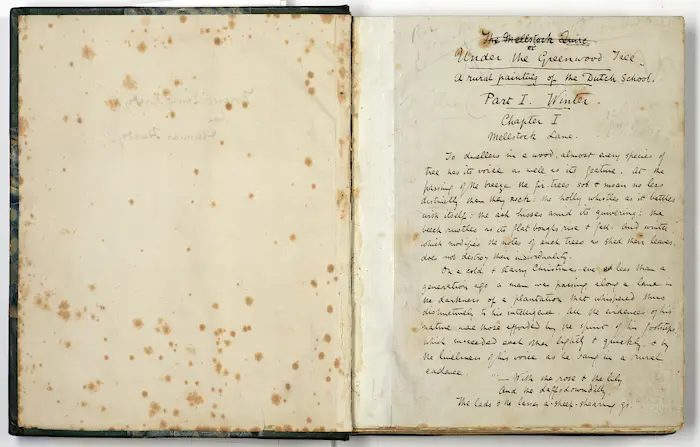
The archive comprises around 150 boxes and folders of material which help us to understand more about Thomas Hardy’s professional and personal life, his upbringing, his family and his interests. Items include manuscripts for three of Hardy’s major novels: Under the Greenwood Tree, The Mayor of Casterbridge and The Woodlanders; and two of his poetry collections: Satires of Circumstance and Late Lyrics and Earlier, as well as a number of loose poetry manuscripts. All of Hardy’s notebooks known to be in existence are held in the collection, apart from one, and these offer rich insights into his sources of inspiration and his ways of working. Over 5,000 letters from around 1500 correspondents illuminate Hardy’s social and professional networks, as well as the key historical events and movements of his lifetime, including the First World War and campaign for women’s suffrage.
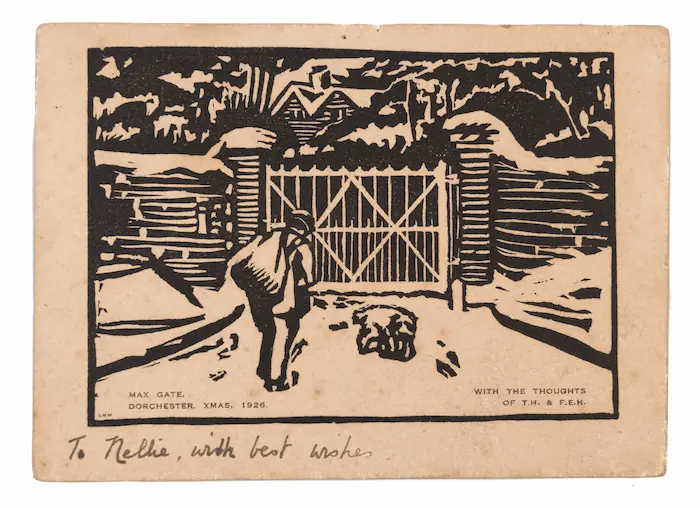
Hardy’s architectural career is represented in the archive by a significant number of architectural drawings, both for professional projects and for his home Max Gate, which Hardy designed and the Hardy family building firm constructed. Hardy’s interests in music and art, which he shared with family members are represented by a number of drawings and sketches by Hardy and his sister Mary. The Hardy family music books, passed down from Hardy’s grandfather, contain manuscript scores for religious and secular music.
Hardy was photographed from his teens until his late eighties, and the archive also includes photographs of many of Hardy’s relatives, including his mother, father, siblings and wives, Emma and Florence. The voices and opinions of Emma, Florence and Hardy’s youngest sister Kate, are revealed though correspondence, diary entries and other papers. In addition to material created by Hardy family members there are also a large number of papers which relate to Hardy’s legacy, including theatre and film productions of his work, academic research, exhibitions, conferences and events.
Project partners, collaborators and volunteers
Throughout the cataloguing project Dorset History Centre collaborated with organisations and individuals, fostering engagement with the archive and benefiting from a wealth of knowledge and expertise about Thomas Hardy and his works.
DHC invited representatives from Dorset Museum and Art Gallery, The National Trust, The Thomas Hardy Society, and the University of Exeter (Professor Angelique Richardson) to join a steering group to help support and inform the cataloguing project. The Project Archivist (Ruth Burton) also supervised an intern from The National Trust who explored how archive material could inform conservation work at Hardy’s Cottage and Max Gate, and reveal a sense of Hardy’s domestic and creative life at home. The intern (Emma Allen-White) also contributed her experience and knowledge of these properties to help identify, describe and date related material in the archive.
For 20 weeks of the project, a group of volunteers came in once a week, and helped to catalogue over 1300 letters. Their knowledge of the local area, history, and Hardy, as well as their generosity with their time was an invaluable asset to the project and they were awarded Team of the Year at Volunteer Centre Dorset’s volunteer celebration evening.